
By Bryce Ives
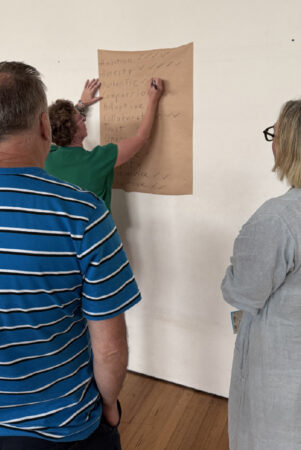
On a February Saturday afternoon in Footscray, a group of locals gathered at the Body Voice Studio, that wonderful community space in Wolverhampton Street, Footscray, once a Squash court and now a thriving hub of community doers and creatives.
In the room, we had community members from Maribyrnong, Williamstown, Seddon, Footscray, Yarraville and beyond. Some have been involved in civic life for years. Others say it’s the first time they have attended anything even vaguely political.
What brings them together isn’t a candidate announcement or an election launch. It is a question: what would real, inclusive representation look like in the Inner West?
As someone who works as a facilitator, I spend a lot of time in rooms where difficult conversations unfold. Often, those conversations are framed by deadlines, budgets or political agendas. This felt different. There was no rush to land on a slogan. No one trying to win the room. Instead, there was a steady willingness to sit with complexity and a shared ambition for our community.
The gathering was inspired by the broader “Voices” movement across Australia, community-backed independents who have reshaped parts of our federal landscape. Cathy McGowan and Helen Haines demonstrated that politics can be built from the ground up through listening first and careful design. But what unfolded in Footscray wasn’t about copying anyone else’s template. It was about asking what makes sense here, in our community. It is also connecting that knowledge and learning from what has built successful and sustaining “Voices” groups nationally.
And “here” is a place of contrasts.
The Inner West is proud, creative and diverse. It is home to long-standing migrant communities and newly arrived families. To renters and homeowners. To public housing residents and small business traders trying to keep their doors open. To young people growing up in the heat of climate change, and older residents who have seen the suburbs transform over decades.
As the conversation deepened, the mood in the room shifted from politics to what connects us.
People spoke about wanting to be respected, not managed, not talked down to. Several described a weariness with politics that talks at communities, sells to them, and then disappears until the next election. There was frustration with decisions that felt distant from lived experience, whether that’s housing pressure, small business survival, or the reality of raising kids through longer, hotter summers. One person said they had simply stopped engaging because it felt pointless. Not out of anger, but fatigue.
The conversation moved beyond policy positions and towards something deeper: trust. What builds it? What erodes it? And what would it take for people to feel that their perspective genuinely shapes outcomes, not just campaign messaging?
Again and again, the same idea surfaced: listening has to be real. If someone gives their time and shares their experience, they deserve to see what happens next. Even if there isn’t agreement on every issue, and there never will be, trust grows when decisions are explained honestly. When a representative can say, “Here’s why I took that position,” and stand by it.
We began to articulate a shared “Southern Star”: to provide real, inclusive representation for the Inner West and to offer a vision beyond political cycles. That phrase, beyond political cycles, seemed to resonate. Many in the room spoke about the fatigue of constant short-term thinking. They wanted something steadier. Something that holds the long view, especially for young people and for the liveability of this place we call home.
What struck me most was the emotional shift.
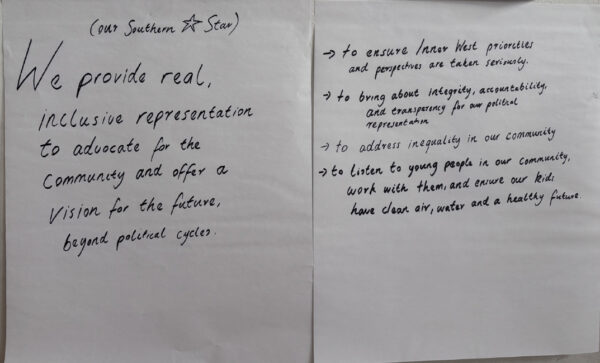
When we asked what “doing politics differently” should feel like, people didn’t reach for policy language or election promises. They spoke about wanting community members to feel safe to speak. Included, even if they don’t identify as political. Heard, not harvested. Proud of something local that reflects the best of who we are.
That pride matters in the Inner West. We see it at the Yarraville Festival, at markets and sporting clubs, in the redevelopment of the Footscray Community Arts Centre, and in the everyday rituals of cafés and dog parks. There are also real and genuine tension points. For instance, my office is right in the heart of the Footscray CBD and it has never felt more divided than now. Friends and neighbours live with the ongoing trauma of the Maribyrnong floods. Many of us feel increasingly concerned about pollution and the lack of clarity and transparency from the government. Community safety is front of mind in many conversations. Civic life here has always had texture. The question is whether representation can match that texture.
By the end of the workshop, this wasn’t just a good conversation.
We had shaped a clear vision and a shared set of values. We had agreed on how we would behave: listening first, being transparent about decisions, staying accessible, and refusing to become a faction or personality project. And we formed a small committee to steward the next phase.
The next step is simple and deliberate: community listening. Throughout March, we’ll be holding kitchen-table conversations across Maribyrnong, Footscray, Seddon, Yarraville, and surrounding suburbs. Small groups. Structured questions. Space to speak honestly. We’ll show up in community spaces to ask: what needs to be taken seriously here? What would build trust? What does it look like to do politics differently here?
Only after that listening process will we move toward calling for expressions of interest for an independent candidate. Not the other way around. That sequencing matters because too often, politics begins with a person and then searches for a platform. We are attempting the reverse: begin with community priorities, make them visible, and then find someone capable of representing them with integrity.
It’s slower. It’s more demanding. It requires patience and discipline. But in the Body Voice Studio that afternoon, there was a shared understanding that if we want politics to feel different, we have to do it differently from the start.
The Inner West has always had strong civic DNA. We care about liveability, fairness, creativity and the future our kids will inherit. The question is whether we can channel that energy into a form of representation that is genuinely local, inclusive and accountable.
That experiment has begun.
If you are interested in joining us for a Kitchen Table Conversation in April, or are interested in our process, please reach out to the Voices of the Inner West of Melbourne.
Bryce Ives is the Principal of YoBou Pty Ltd, is a member of the committee of Voices of the Inner West of Melbourne, and has lived in Footscray and Yarraville since 2009.




It’s genuinely encouraging to see the inner west mobilising like this. The demographics and needs of this corridor have been evolving rapidly, and communities like Footscray, Yarraville and Maribyrnong deserve serious representation that reflects that. I’m not affiliated with any party, but I’ve spent a good deal of time understanding how the system actually works from the Commonwealth down through state government to municipal responsibilities — and I think there’s a more effective path worth considering.
The Voices model is admirable, and the community listening process Bryce describes is exactly the right foundation. But the honest question is: what happens after the election, whether the candidate wins or not? Our Westminster system is built on trade-offs. Crossbenchers — even good ones — are constantly required to pivot, negotiating give-and-take on issues that may have nothing to do with the inner west. And in state seats as safe as these, even a strong independent faces a steep electoral hill before they can influence anything at all.
What this community has — and what the article’s ‘spitball dialogue’ actually surfaces — is a desire for sustained, long-term influence over the decisions that shape this place. That’s a different goal from winning a seat, and it arguably calls for a different vehicle.
A well-structured, non-partisan think tank anchored in the western corridor could do something a couple of crossbenchers almost certainly can’t: influence policy at the bureaucratic level, where decisions are actually shaped before they reach ministers. Bodies like Infrastructure Victoria, the Victorian Planning Authority and the Department of Transport and Planning are where corridor investment gets prioritised or deprioritised — and they respond to compelling economic evidence, not electoral sentiment.
The key ingredient is credibility. An MoU with one or more universities — VU and Deakin are obvious partners given their western presence — would give the body independent research capacity: economic modelling, liveability data, housing supply analysis. That kind of output is harder for any government to dismiss than a community petition or a crossbench vote traded for something unrelated.
The community energy being built right now — the kitchen table conversations, the shared values, the civic infrastructure — is genuinely valuable. The question is whether it gets channelled into a single electoral campaign or into something that holds governments accountable across multiple cycles, regardless of who wins.
I’d gently suggest the ‘doing politics differently’ framing in this article is exactly right — but a think tank with real research muscle and bipartisan access might be the most different thing this community could do.