By Lev Burke
RMIT journalism intern
A major milestone was reached last month as the More Trees for a Cooler, Greener West program planted its 500,000th tree.
Around 350 volunteers took part in the annual event at Victoria University’s Werribee campus, where they managed to plant 2,500 trees.
The event has taken place over the past several years and VU has been able to celebrate its own milestone: 20,000 trees planted on its campus alone.
The tree planting program is part of a larger effort by multiple organisations to help combat climate change and create a greener environment in Melbourne’s western suburbs – a region known to be an urban heat island due to its lack of tree canopy.
“Since 2021, the More Trees for a Cooler, Greener West program has been transforming streets, parks and schoolyards across Melbourne’s western suburbs, with 500,000 more trees now providing shade, cleaner air and cooler neighbourhoods for communities to enjoy for generations to come,” explains Hamish Brooks, a spokesperson for the Department of Energy, Environment and Climate Action (DEECA).
“Trees have been established in parks and reserves, along roads and shared user paths, and throughout residential and industrial areas to help reduce urban heat, improve amenity and support biodiversity”.
The Victorian Government launched the programme in 2021 with the aim of hitting the half-a-million mark by 2026 and has achieved this target with the help of VU, led by Fatih Tuncer, the VU in the Community Manager.
Mr Tuncer says the program has been successful and has made a difference to the VU campus. He says the space at the Werribee Campus where 20,00 trees have been planted was previously barren land. “Now you’ve got trees there, and the most beautiful thing about it is as soon as you head into that space you hear the birds chirping, you hear the native wildlife that is around.”
“Victoria University is unique in that we are very invested in the community… When we saw this initiative, it was quite important for us because we wanted to contribute to this space,” says Mr Tuncer.
Mr Tuncer says the community came together for the milestone planting event creating a festive atmosphere.
“It’s great that so many people signed up to it and we didn’t really even have to push hard with the promotion of the event,” Mr Tuncer says. “People knew it was coming up, they wanted to be part of it… The relationships that you build out there when you are planting together are very different.”
2026 will be the final year of the initiative, but Mr Tuncer says that VU will still be on the lookout for opportunities to connect the community and improve the environment in the West.
“It’s something we would love to explore. The programme has come to an end. But if we do find other opportunities we will [partake]”.
According to 2018 data from RMIT and the Department of Transport and Planning Melbourne’s west has the lowest tree coverage in the city with only 5.5% canopy. That’s compared to 12.1% in the north, up to 15.2% in the south and a leafy 25.9% in the east.
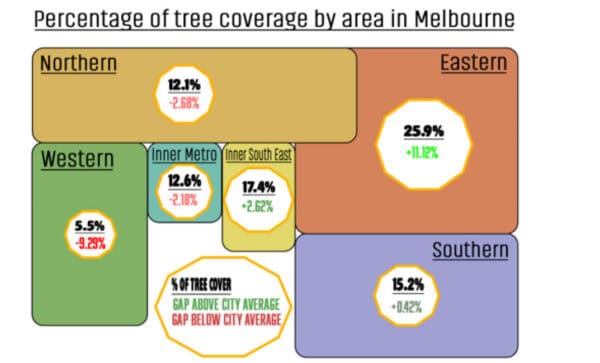
This leads to an urban heat island in the West: hot days are going to be even hotter, as there is little to protect roads and buildings from the heat.
“One main issue is the urban heat island effect where roads, buildings and other hard surfaces absorb and retain heat, whereas when you have a tree canopy it’s a very different story,” says Mr Tuncer.
Tree planting initiatives will go some way to combat the problem, but there is still a lot of work to be done. The next step for DEECA is to commission another Melbourne-wide survey of tree canopy to assess the change since 2018.