
By Graeme Reilly
Altona Laverton Historical Society
It was one hundred years ago on 2 October 1926 that Altona’s first electrified rail service commenced operations, replacing steam locomotives and joining this rail line to Melbourne’s great electric railway system.
Melbourne led the way in Australia when electric trains began between Essendon and Sandringham stations on 28 May 1919 and this was expanded to cover the broader suburban area by 1923. Sydney followed suit seven years later when its first electric train ran, just seven months prior to the electrification of the Altona line.
The Victorian Railways commenced planning for the suburban railway electrification in the 1910’s but with the start of the Great War in 1914 implementation of their plan slowed up significantly.
Given that the Williamstown Racecourse branch line was electrified in August 1920, why did it take so long to electrify the remainder of this line to Altona? After all, it was only another four-kilometres on to both Seaholme and then Altona.
Williamstown Racecourse branch was part of the Victorian Railways suburban system, but the line beyond the racecourse, to Altona had originated as a private railway associated with the land development and later coal mining use. The original rail line of 1888 only operated for a few years when lack of use forced its closure.
It was leased by the Victorian Railways in 1906 to store race trains. Sometime between 1911 and 1919 the line reopened for goods trains with a siding built from Altona Beach to the Melbourne and Altona Colliery Company mine near today’s Harrington Square.
From November 1917, the Victorian Railways worked on the line on behalf of the then owners, Altona Beach Estates Limited, but to a relocated Altona Beach station at Pier Street. The original Altona Beach Station was situated west of Grieve Parade, formerly Lily Street.
Beginning on 1 December 1917 a rail service of ten trains ran on weekdays and Saturday with additional workmen’s trains run in the morning and evening. There were five trains operating on a Sunday. The service was operated by the Railways department under a guarantee from the Altona Bay Estates Company.
The Victorian Railways took control of the line and station on 1 October 1924 when the company owed the railways some £7,289 through their guarantee against operating losses. Two years later electric trains commenced operation on 2 October 1926. Work to electrify the line commenced in April 1926 and was completed just six months later.
There was a large crowd on the day of the opening, taking up all the space on the station platform, Pier Street, and on the south and north side of the track in front of the train. The station and streets were decorated with flags and posters, and the town took on the appearance of a festival.
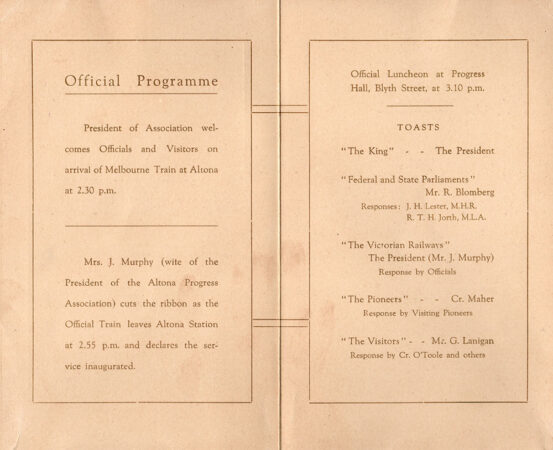
The festivities started upon the arrival of the 2 pm train from Flinders Street and the dignitaries onboard were welcomed by the members of the Altona Progress Association, led by their president, John Murphy. The association, and leading residents had petitioned hard for the reinstatement of a train service and now Altona was connected to the electrified suburban rail network.
At 2.55 pm, Mrs Nellie Murphy, the wife of John Murphy, leaned from the train drivers window and cut the dividing ribbon with a pair of scissors presented by Mr Ralph Hjorth, M.L.A., and declared the service inaugurated. These scissors remain a central part of our collection at the Altona Laverton Historical Society.
At the time of electrification there were only two stations on this line, Seaholme and Altona Beach, with the name of the latter station’s name being shortened to Altona in 1938, and Williamstown Racecourse station only being used on race days.




Fantastic – Educational Historic article.
In the 1950’s – living as we did then in west Footscray but with friends in Altona, it was MMBW bus from West Footscray to Footscray, then a “Red” Rattler – train from Footscray to Newport, then off at Newport, wait on the platform for the “old” swing door “Red” rattler, to come in behind after the Williamstown Pier train – remember that now closed WRONGFULLY station – had departed and then off to Altona Station.
It was VINTAGE travel but I remember it well.
The Williamstown Racecourse was still back late 1950’s quite visible to recognize its position and layout although the fired destroyed stand was rather Ghostly.
The GREAT Phar Lap and Ajax plus “other” quality racehorses at the time raced at the “Manicured” as it was referred – Williamstown Racecourse which my late parents recounted to me.