From the archives of the WIlliamstown Historical Society
The period of impressive growth in 19th century Victoria saw the separation of Victoria from New South Wales, the scaling down of the British military presence, the fear of a Russian invasion, and the gold rush – all of which led to The Defences of The Colony Report in 1858/9. After an appeal to Britain, an armed vessel, HMS Electra was stationed at the head of Port Phillip Bay.
Victoria was actively building its own navy. In 1858 The Victorian Brigade was formed and in 1865 the Colonial Defence Act was passed in Britain.
George Verdon (later Sir) is known as the ‘Father of the Victorian Navy.’ As the Victorian Treasurer he went to London in 1866 to arrange the transfer of the Nelson and the Cerberus along with a big number of large guns for the ‘defence of the Colony’ and the protection of its lucrative trade with Britain.
Britain maintained ‘some’ ownership of these colonial vessels. In 1968 HMVS Nelson (Her Majesty’s Victorian Ship) arrived and in 1871 the HMVS Cerberus arrived. The ships were obliged to assist Britain in times of need even though Victoria had had to pay for them.
HMVS Nelson was the first ship to use the Alfred Graving Dock in order to be cut down to a single deck and to install more modern armaments. It was sold as a hulk in 1898.
The monitor, HMVS Cerberus, is the best remembered as her remains still protrude above the water at Black Rock. A ‘monitor’ ship sits low in the water, uses both sail and steam, has iron cladding over a timber shell and is slow and clumsy.
The Williamstown Historical Society has in its collection the Engine Order Telegraph from the ship along with some of the wooden framing and brass screws.
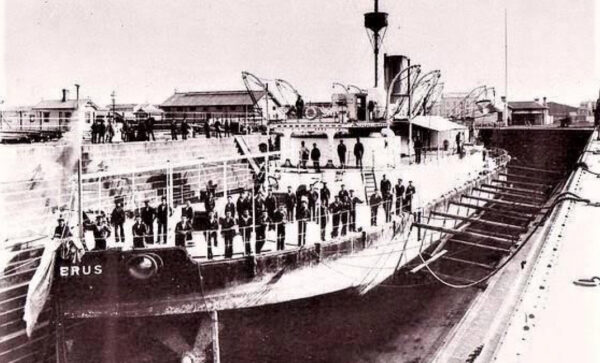
There was sparse tactical training but by the mid 1880’s Victoria’s Navy had added five more warships including torpedo boats and two gunboats, Victoria and Albert. These were supported by land-based Artillery Companies and Batteries were established at Williamstown, Sandridge and the Victoria Barracks in St Kilda Road. The Victorian Naval Forces were considered the most powerful colonial naval force.
Senior officers, captains and commanders leading the Victorian Navy were from the British Royal Navy. Some were on loan but still had junior officers who headed up the naval forces and the Naval Reserve known as the Naval Brigade (disestablished 1895). The men and boys were mainly local residents, some ex-convicts, and fishermen.
After Federation in 1901 the various State naval forces formed The Australian Commonwealth Naval Force with Victoria providing the most vessels, officers and men. The Alfred Graving Dock at Williamstown passed to the Commonwealth also serving as the national training depot until Flinders was built in 1920.
It took some years before Britain’s Admiralty relinquished their oversight of the developing Australian naval force, and in 1910 with the passing of the Naval Defence Act, the formal creation of the Royal Australian Navy whose title was approved by King George V in 1911.