By Williamstown Historical Society
In December 1851 there were only 29 people in prison in Victoria. Two years later there were 955.
When gold was discovered in Victoria in 1851 many able-bodied men fled their jobs to try their hand at prospecting leading to an acute shortage of labour in the community, and many maritime infrastructure building projects were consequently delayed.
The Victorian gold rush also lured to Victoria ex-convicts and escapees – from New South Wales and Van Diemen’s Land – who often re-offended and were sent to prison. The government therefore resorted to using prison labour to assist in some of these projects.
Prisons soon became overcrowded, so the Victorian government decided to use floating prison hulks. In 1852, the first of five prison hulks, the ’President’, was moored off Point Gellibrand in the area between Gellibrand Pier and the Convict Jetty.
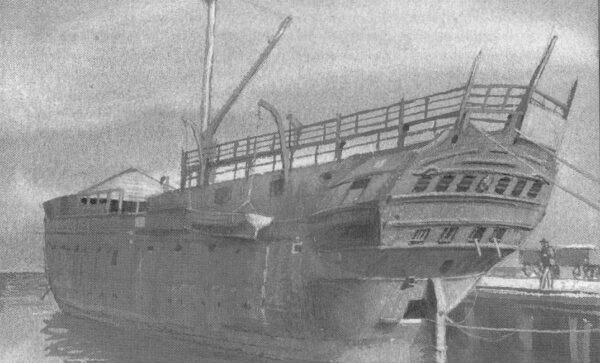
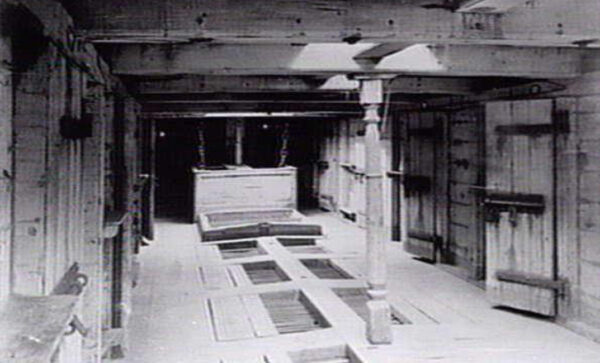
The prison population continued to rise, so the following year the government purchased the ’Deborah’, ’Success’ and ’Sacramento’ for conversion into prison ships, followed by the ’Lysander’ in 1854. The ships had their masts removed and were anchored off Williamstown on Hobson’s Bay. They held the worst offenders in the penal system.
The hulks were painted yellow to distinguish them from other vessel traffic and the hulks continued to be used even after the major Williamstown piers were constructed.
Prisoners from the hulks were engaged in a number of tasks at Point Gellibrand, including quarrying stone, laying out tramways, building a defence battery and constructing a prisoners’ jetty which was the first jetty built at Point Gellibrand (1852–53). It was constructed so that convicts on the prison hulks could be brought ashore via small row boats.
Ned Kelly’s prison record shows he was incarcerated aboard the Sacramento, anchored off Williamstown on 25 June 1873.
The hulks were intended to be a ‘terror to evil-doers’, so conditions were extremely harsh. Prisoners were kept in irons below decks, in cramped conditions with no work and no books. For minor offences they were sent to solitary confinement in dark cells below the waterline.
In 1853, John Price was appointed as the Inspector General of Penal Establishments. The Age described him as ‘a man whose leading characteristics appear to be cunning and cruelty’.
Indeed, conditions on the hulks became even worse under his authoritarian rule. Price took a personal interest in inflicting additional punishment on prisoners. They were put in irons for their entire sentence, and violence and cruel punishments were condoned.
In March 1857, Price went to Williamstown to hear the grievances of the prisoners on the hulks. One prisoner threw clods of earth at him, others threw heavy stones. He was then kicked, beaten and struck with picks and shovels. He died the following day.
The Sacramento and Deborah convict hulks were later used as torpedo stores and ships at the Torpedo Depot before being moved to Greenwich Bay where they are last shown inside land reclamation works being undertaken there in 1879.
In 1885 the Victorian government ordered that the five prison hulks be broken up. The Deborah and Sacramento were gradually dismantled but the Success survived until 1945, after touring the world as ‘the famous Australian convict ship.’