Written by: Jack Huggett, Isaac Haber, Liam Cole, Ben Lawson, RMIT Journalism Graduates.
Melbourne’s west has long been the mecca of multiculturalism, the fabric that binds communities together.
From the vibrant fresh produce markets in Footscray, to the aroma of Vietnamese bakeries and the energy of local sporting activities, diversity is the backbone of Melbourne’s west.
Being able to speak English is an important cultural aspect of being part of the west, as it bridges the gap to meeting new people and learning, but teaching the English language often takes a backseat.
Teaching English to Speakers of Other Languages in Victoria (VicTESOL) is the representative body for teaching English, supporting schools with their TESOL, and English as an Additional Language (EAL) programs.
However, the association is concerned that EAL learning is falling through the cracks.
“EAL can slip out of priority when there are other operational kinds of needs,” says a VicTESOL spokesperson.
EAL is a crucial component of the education system. It serves as the cornerstone in educating children from language backgrounds other than English, and is widely integrated throughout the education system, from primary to secondary, to the VCE curriculum and beyond.
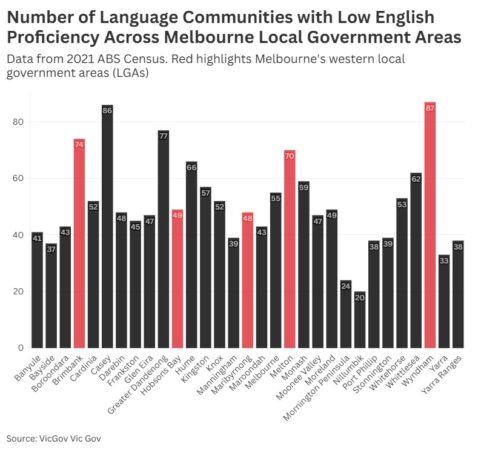
From 2009 to 2019, the Victorian Department of Education and Training reported a 69 percent increase in EAL students. In the latest 2023 EAL report, Victorian government schools enrolled 8,020 EAL learners (students who have been in Australia for less than two years and require EAL support).
In addition, Melbourne experienced the most significant population boom of any Australian city from 2023 to 2024. According to the Australian Bureau of Statistics (ABS), the city welcomed 142,637 new residents with nearly 85 per cent immigrating from overseas.
Melbourne’s west is at the forefront of this growth, undergoing some of the highest population growth rates across the country, particularly in the outer suburbs.
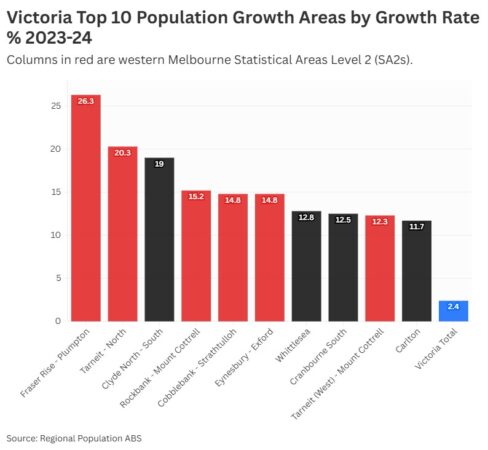
However, VicTESOL says systems are not yet in place to accommodate future EAL learners.
“One of the biggest issues in the western suburbs is the lack of new arrival centres,” says a VicTESOL spokesperson.
“There is quite a dearth as you go out, so you know areas that are on the outskirts, your areas where migrants are going. There will not always be access if they need to go to a new arrival centre. They would have to travel quite far.”
“They are kind of pushed straight into the mainstream regardless of whether the schools are equipped for them or not.”
Centres such as Djerriwarrh Community & Education Services in Sunshine and Melton, play a crucial role in providing English language teaching for children and adults but are facing an ageing and shrinking workforce.
“We hear things (are difficult) particularly around qualifications and employing people that have TESOL qualifications; we also hear how difficult it is to find those people,” says the VicTESOL spokesperson.
“I think pathways in initial education teacher qualifications are always going to be an issue. How many universities are offering an EAL-specific qualification?”
To make matters worse, some universities have removed their English language qualification programs, including La Trobe University’s Applied Linguistics and Master of TESOL courses, due to a dip in international student enrolments.
Djerriwarrh Community & Education Services says that being able to support students in reading, writing, and using technology for the first time is an “incredibly satisfying” incentive for becoming an EAL teacher.
“English language and literacy teachers transform lives by helping students gain essential skills, opening doors to employment, further education and independence”, said a Djerriwarrh Community & Education Services spokesperson.
“You will support students from diverse backgrounds – recently arrived migrants, young adults, those re-entering education and those looking for a career change.”
Greens MP and spokesperson for Schools, Tim Read, is another passionate advocate for the state government to prioritise education.
“Everything in education is being underfunded, and the education department needs more financial support,” said Read.
Mr Read questioned the money being spent on level crossing removals and the Grand Prix.
“I think we can afford to put more money into education, and funding things like EAL is not necessarily that expensive, particularly when you think about the costs that might be avoided in the future.
“If people coming here have more confidence in their ability to communicate and get things done … they can find their way in society better and as a result, we are less likely to be spending money on other things that we might have to do if people are trapped by not having adequate English.”
However, not everything in Victoria is a funding fix.
Located in Point Cook, the most multicultural suburb in Australia according to the ABS 2021 Census, Saltwater P-9 College educated 2,180 students in term one last year.
Saltwater Assistant Principal Ryan Ma believes funding is only part of the issue and says schools are becoming “more adaptive”.
“To rely solely on the funding, to think that that is going to solve all of the issues, I think that is just dreaming, really? “ said Ma.
“If you gave a million dollars, for instance, I do not know if that is going to solve the EAL teaching.”
“You can probably buy aids, you can buy translators, you can buy technology to go and help that, but at the end of the day, it is still up to the classroom teacher and the structures that they put in place and the school structures that they put in place to help support those EAL students.”
“The best way to get students to pick up English is to be immersed in it,” Ma said.
So what is next for ‘The Education State’?
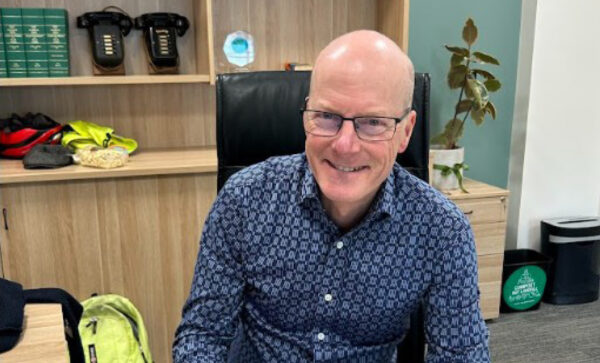
In May last year, the Greens Party proposed a parliamentary inquiry into why the state government has failed to meet the 2011 Gonski Report recommendations, a move that may affect EAL programs.
“They (Labor Government) do not want to have to talk about this in public, they really don’t,” says Read.
“The government did not want that inquiry to go ahead, but we are pushing on with it. Moreover, it will be an opportunity to expose what is going on here. Furthermore, it is essentially a public examination of these issues.”
In response to this issue, Deputy Premier of Victoria and Minister for Education Ben Carroll advised: “The Victorian Budget 2025–26 provides $55.1 million to meet increased demand for EAL teachers and support in government schools.”
Opposition Leader Jess Wilson and the Australian Education Union did not respond, or agree, to interview requests.
As debate over funding and accountability unfolds, educators, policymakers, and communities alike will watch closely to see if ‘The Education State’ can live up to its name — ensuring every student, no matter their background, has the support to succeed.