By Gabriel Mills-Connolly
Many people don’t know this but the travel corridor from West Footscray station to Tottenham has been designated an ‘Activity Centre’. According to the state government an Activity Centre is a place with ‘good access to public transport, jobs, and services.’
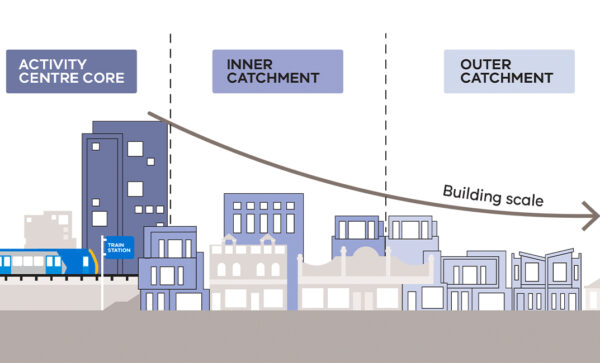
The Activity Centres Program (AC Program) overrides council planning rules in order to open up high rise construction of up to 12 storeys close to train lines, transitioning to three to six storey buildings as the plan extends 800m out into the surrounding area.
In 2023, the state Government released Victoria’s Housing Statement. It was a response to the housing crisis we have found ourselves in and its key focus was to increase supply and improve affordability.
The suburbs subject to a rezoning review are West Footscray, Braybrook, Tottenham, Seddon, areas in the north of Yarraville, and the west of Footscray.
The first phase of its consultation program commenced in May and ended mid-June with drop-in sessions hosted at West Footscray library and online.
Much smaller, and selected, Community Reference Groups have been conducted and the phase two report is expected to be released ‘late 2025’.
What do the experts say?
Professor Joe Hurley is a member of the Centre for Urban Research and is an expert in the field of sustainability and urban planning.
He says housing needs to be built thoughtfully, carefully and strategically but says “that’s not the environment we have in Victoria.”
Professor Hurley says activity centres need to be more concentrated and less dispersed. “We need to integrate more diverse and sustainable mobility options … so we aren’t dependent on the automobiles.”
“Just pump priming supply of market housing is not a very effective way of increasing housing affordability in ways that matter to those who are most vulnerable.”
Linda Allison is the CEO of the urban development advocacy group Urban Development Institute of Australia Victoria and doubts that the market will solve the supply issue.
“Some of the market conditions are making it very difficult to build,” she says. “Construction costs have skyrocketed because of a global supply shortage and demand for the big build.”
“The bank won’t lend against projects unless you can sell at a certain point.” She says the government’s Big Build program “pays far more attractive prices” and that government levers, like reducing windfall and land tax laws, will be more effective.
Dr Liam Davis also doesn’t have much fatih in market solutions. He’s an RMIT lecturer in sustainability and urban planning and says a lack of supply is not the only cause of housing in-affordability.
“Market related supply can’t be the only way we try and achieve affordability, we need other things. Developers will intentionally withhold supply from the market to stop prices going down…financiers won’t lend [developers] money in a saturated housing market.”
“We would get a far better outcome if the government were more involved,” he says. “Effectively buying land, readying for development and hiring developers and builders to do the work on their behalf, fronting some of the cost.”
Meanwhile the YIMBY (Yes In My Back Yard) pro-development movement believes the program is an “overwhelmingly positive” example of good planning policy. Jonathan O’Brien, lead organiser of YIMBY Melbourne, says land scarcity is an artificial issue created by restrictive planning.
“You want to see as much land as possible opened up for development, because then no given piece of land has bargaining power over everyone else. Supply is the ultimate affordability solution, every other affordability solution is supply with extra steps.”