By Frances Atkinson
If you happen to be around Footscray Station around 4pm, you might spot a flock of pigeons wheeling over the west. Packed together they resemble a storm cloud, but when they break formation, those squat creatures perform tight turns with precision and elegance. You’ve just spotted Kenny’s birds.
The Bunbury Street local, now in his early 70s, keeps about a couple of hundred pigeons in his two-storey loft. His admiration for the birds started when he was about fourteen. “My family kept chooks and one day, a pigeon landed in the shed. Its feathers were shining and I thought, ‘I like them’.”
Despite dealing with some health issues, Kenny’s determined to keep his birds in peak condition. “I’ll come good eventually, and when I do, I want my birds fit and ready to race. I let them out each day for about an hour. You have to train them – that’s why some people call them ‘the athletes of the sky’.”
Sadly, pigeons have been called much less-flattering names, most commonly ‘rats with wings’. It’s an unkind stigma for a bird that, historically, was known for acts of heroism. In both WWI and WWII, pigeons delivered crucial communications between allies, often during heavy fire.
You don’t need to convince Matthew Ciancio, Secretary of the Yarraville Pigeon Club, that the birds are special. The 51 year-old from Sunshine is a second generation pigeon racer. His late father Nicolo (aka Nick The Chancer) remains a legendary figure among the racing fraternity.
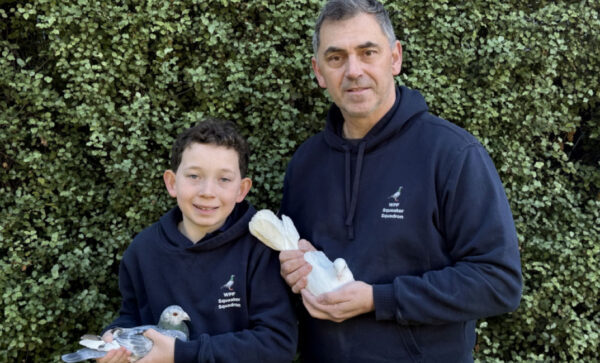
Matthew and his eleven-year-old son Charlie proudly give me a tour of their immaculate backyard loft, which is home to around 120 birds (the oldest bird is eleven). A clean loft produces healthy birds – bright eyes and feathers packed tight and smooth. Matthew scoops up a nearby pigeon and gently unfolds a wing like a paper fan. “It’s a lot of work. I’m out here cleaning at least twice a day.”
Located near the loft entrance is a small unit that electronically tracks every bird via their leg ring, along with calculating race times down to the second. “It’s synchronised to my phone, so I know when every single bird comes home or how they perform on race day,” says Matthew.
On Saturdays, Matthew meets up with members of the club to race in competitions, connect with community, and foster the next generation of young flyers. The club, which celebrated its 100 anniversary last year, has about 25 kids who are part of the Squeaker Squadron, where they learn how to race, and develop skills.
“We’re working on attracting new people to the club. It’s very social and everyone’s more than happy to talk about their birds. It’s a great hobby that can easily turn into an obsession,” says Matthew.
Paul Camilleri, member of the Western Pigeon Federation, has been racing pigeons for decades but decided to retire from the hobby a few years ago; that is, until he lost a close friend. “Before my mate died, he made me promise I’d look after his birds,” he says. And so Paul found himself back training.
The birds can cover remarkable distances. Initially Paul trained his birds in sessions. Short flights of around 50km, then 70km. Now his pigeons can fly around 900km.
Just how the birds know how to get home still remains a mystery, but there are plenty of theories.
“It’s just the way they’re made”, says Matthew. “There’s lots of debate at the club; magnetic fields, position of the moon, it’s all very interesting.”
Paul loves his birds, but avoids picking a favourite. “If you have a favourite, you can bet that’s the bird that won’t make it home.”
Matthew, on the other hand has a couple of favourites: Ruby’s been known to watch the occasional footy match in the lounge room, while Super Girl is a reliably good flyer. But he’s also experienced the disappointment that comes when a bird doesn’t make it home. Around five percent of birds fail to return to their owners.
Unexpected bad weather can play a part, but until a few weeks ago, it was the birds of prey (goshhawks and peregrine falcons) that were pigeons’ number one enemy. “The falcons tend to attack the flock mid-air, but sometimes the hawks will try and get into the loft – they’re pretty ruthless.”
Recently however, Victoria announced a poultry lockdown to prevent the spread of bird flu but Victoria’s Chief Veterinary Officer lifted the temporary flying ban for large pigeon lofts, allowing racing and training to resume. According to Agriculture Victoria, pigeons are considered more resistant to avian influenza than other bird species but infection is still possible.