By Eric Mwamba
Melbourne’s West is no longer simply the city’s outer edge. It is becoming a city within the city.
New homes are spreading across Wyndham, Melton and the western growth corridors. New railway infrastructure is arriving. Roads are being upgraded. Schools, hospitals, industrial estates and employment precincts are reshaping the economic geography of the region.
Yet beneath the infrastructure announcements lies a harder question:
Is Melbourne’s West developing the jobs and services needed to keep pace with its rapidly growing population?
The answer is neither simply yes nor no. The West is creating jobs, and creating them quickly. But population growth, employment growth and transport infrastructure are not always arriving at the same speed or in the same places.
That gap could shape the region for decades.
Infrastructure Victoria estimates that Melbourne’s growth areas will gain around 840,000 residents by 2036, but only about 250,000 additional jobs.
The agency says residents of growth areas can face greater difficulty reaching employment and training opportunities within reasonable travel times. Public transport and community facilities are also less developed than in established suburbs.
The issue, therefore, is not simply how many people Melbourne’s West will accommodate. It is what kind of urban economy those people will inhabit.
Wyndham offers a more complicated picture.
Between 2020 and 2023, the municipality’s population increased by 13 per cent. Over the same period, local employment increased by 22 per cent to 110,531 jobs, while the number of registered businesses increased by 47 per cent.
The economic base is clearly expanding. But there remains a striking gap between where people live and where they work.
In 2023, only 39 per cent of Wyndham’s 138,460 resident workers were employed within Wyndham.
Wyndam City Council has set a goal of increasing that proportion to 45 per cent by 2040. That means the West is not failing to create jobs. It is struggling to create enough jobs close enough to where its residents live.
Further west, the challenge becomes more pronounced.
Melton City Council says there are currently only 0.38 jobs for each member of the local labour force, compared with 0.6 across Melbourne’s growth areas.
The Council says 73 per cent of its local workforce leaves the municipality to access employment.
Without a significant change in the employment trajectory, it projects a potential shortfall of around 100,000 jobs by 2051, with daily commuting potentially increasing from approximately 45,000 trips in 2021 to 110,000 by 2051.
That is more than a transport problem. It is a question about the economic design of a city.
If population growth consistently outpaces local employment growth, roads and trains are forced to carry the burden.
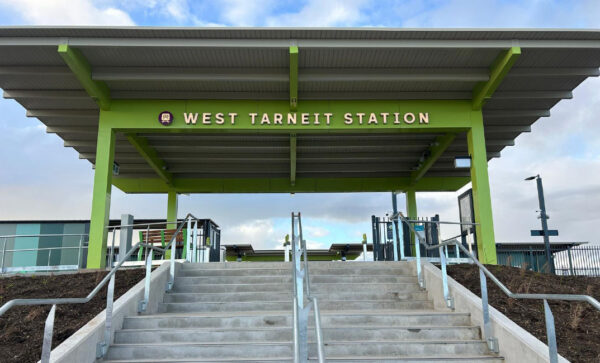
The response is already substantial. West Tarneit now has its own railway station, while new and expanded bus services are being introduced across the growth corridors.
But Infrastructure Victoria says Melbourne’s western growth areas still have relatively limited public transport. Across Melbourne’s outer suburbs and growth areas, it estimates that 63 per cent of residents drive to work, compared with 32 per cent in inner Melbourne.
The agency has recommended extending metropolitan train services to Melton, building additional tracks between Sunshine and Caroline Springs, and delivering new stations at Thornhill Park and Mount Atkinson.
Its estimated cost for the proposed rail package is between $4.3 billion and $5.7 billion.
The scale of the proposed investment tells its own story. The West is growing faster than the transport network was originally designed to accommodate.
It is tempting to measure the success of Melbourne’s western expansion by the number of stations opened, roads widened or houses approved.
But infrastructure is only part of the equation. A railway station can move people. A freeway can move cars and freight. A bus can connect a suburb to a railway line.
None of them, by themselves, creates a local economy.
That requires employers, education, healthcare, retail, professional services, cultural institutions and opportunities for people to build careers close to home.
There are strong reasons for optimism. The Victorian Government projects that 210,219 new workers will be required in Melbourne’s western region between 2024 and 2034.
The strongest areas of projected demand include health care and social assistance, construction, transport and logistics, retail, education and training. That represents a significant economic opportunity.
The question is whether those jobs will be accessible to the communities being built around them.
If employment grows in the same places as housing, the West can gradually reduce its dependence on long-distance commuting.
If housing continues to grow substantially faster than local employment, infrastructure will be forced to carry more people across the metropolitan area every day.
Wyndham illustrates the transition already underway. Its economy is growing. Its business base is expanding. Its local employment is increasing. But fewer than four in ten resident workers currently work within the municipality.
Melton illustrates how much further some parts of the West have to go.
Together, they suggest that the next phase of Melbourne’s western development cannot simply be about accommodating more people. It must be about creating more economic opportunities for those people.
For decades, Melbourne’s West was often described as the city’s outer edge. That description is becoming increasingly outdated. The population is too large. The investment is too substantial. The economic activity is too significant.
The West is becoming a major part of Melbourne in its own right.
But becoming a major population centre and becoming a genuinely self-sustaining economic centre are not the same thing. The distinction matters.
A region can be well connected without being economically independent.
It can have excellent roads and trains while still requiring large numbers of residents to travel long distances every day for work.
The challenge for policymakers is therefore not simply to connect the West to the rest of Melbourne. It is to make the West itself more economically connected.
Melbourne’s West is entering a new phase.
The question is no longer whether the region will grow. The question is whether housing, transport, employment and services can grow together.
That means judging new infrastructure by more than the number of houses it serves or the number of passengers it carries.
It means asking whether it helps create places where people can work, study, access services, build businesses and participate in community life without having to cross half the metropolitan area every day.
The ultimate measure of a successful growth corridor is therefore not how many houses it can build. Nor is it how quickly a train can carry residents somewhere else.
It is whether people have a choice: to leave because they want to, or because they have to.
That may be the real test of whether Melbourne’s West is finally becoming a city.