By Helen Fairlie
According to Royal Life Saving Australia one in four adults are either weak swimmers or non-swimmers. Yet with patience, persistence and a good teacher, adults of any age can learn to swim.
It was a hot February evening in 2022 when I opened the Swim School door for the first time. I must have looked scared. I was finally facing my fear of deep water and the shame I felt in being unable to swim. A voice behind me said “You’ll be okay.”
Looking back over the past four years of swimming lessons, I was okay.
I had always wanted to swim and glide gracefully through the water unafraid of its depth, but as my childhood years grew more distant, rolling them back became more daunting. I was an Australian born child who had grown up unable to swim. I avoided swimming pools and felt ashamed that I had been left behind when my classmates were learning to swim. I even believed I was the only person in the entire world who had never learned to swim as a child. But when I migrated across the Westgate Bridge to live in Hobsons Bay, minutes away from the beach, my perspective changed.
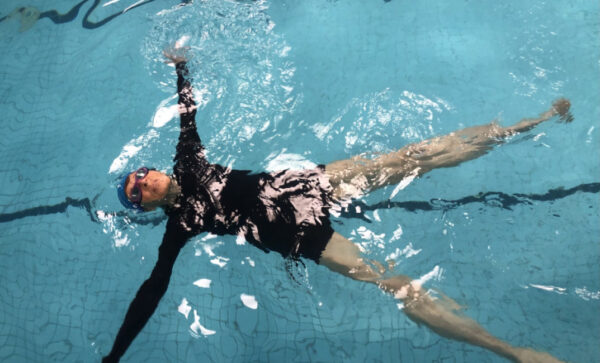
Having Altona beach so close to home meant that we often walked along this lovely stretch of Hobsons Bay, wading in the shallow waters that extended well out from the shore. It was the bay itself that awoke within me my long-forgotten swimming dream. I found a local swim school called Paddles close to home. The Manager, Debbie, assured me that adults can and do learn to swim confidently and overcome their fear of water. The warmth and confidence of her voice reassured me. There was an adult vacancy for the following year. I enrolled feeling both apprehensive and excited, knowing I had finally chosen to overcome my lifelong fear of deep water.
Stepping into Paddles’ swimming pool as a student was unforgettable. I was no longer the only adult who had never learned to swim. There were three other adults in the world who had never learned to swim. Our teacher was a patient young man who inspired confidence and made us feel relaxed. Learning to flutter-kick and propel myself forward was far more difficult than doing a law degree and took almost as long. But I kept going week by week, until I began moving through the water. By this time, my three fellow students were learning deep water skills. Knowing that one in four Australian born adults is either a non-swimmer or a poor swimmer, helped me realise that when my three fellow students left the swim school behind, three more adult students would take their place and I would not be learning to swim alone. In fact, as the years advanced and I was learning different swimming strokes, I encountered a steady flow of adult students. Many of them were from landlocked countries and had not had the exposure to water in childhood that Aussies take for granted. But each of them had the courage to roll back those childhood years of being unable to swim.
Learning to swim as an adult cannot be fast tracked. Having technically competent teachers who are patient, encouraging and understand the challenges faced by adults is a sound foundation. A foundation that can be built upon by practicing in a local pool, watching swimming videos to improve technique, and sometimes staying back to watch the more advanced children’s classes. The more time I spent in the water, the more confident I became. Debbie, the Manager was right. Adults can, with patience and practice, learn to swim confidently, gracefully, and efficiently.
From walking into a swim school as a scared adult to becoming confident and competent in deep water has been, for me, a challenging and enjoyable journey.
It’s never too late to unroll non-swimming years and conquer deep water fears.