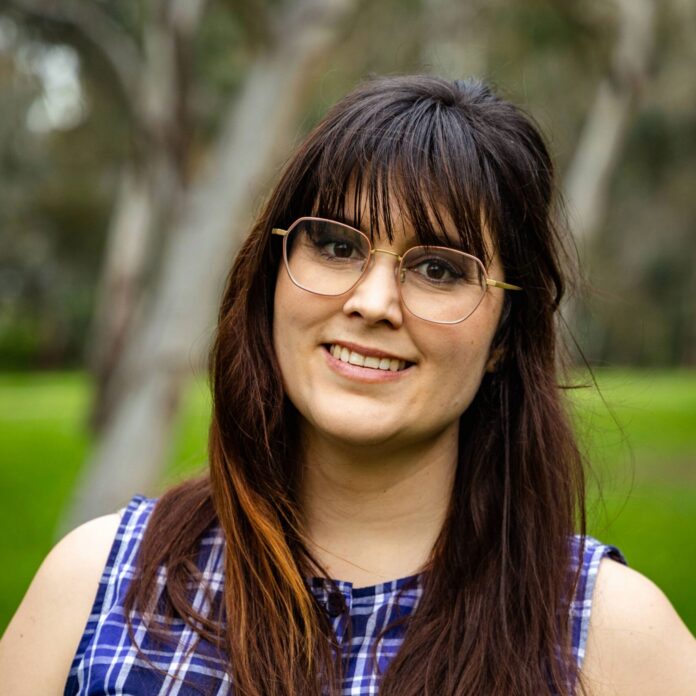
Salomae Haselgrove

Salomae Haselgrove has lived in Melbourne for seven years and the inner north for two and a half of those. She grew up on South Australia’s Fleurieu Peninsula, where from childhood she developed a love and passion for healthy oceans, environments, and animals, inspired by her parents, her mother having 30+ years in public education, and both parents working for Greenpeace in the 1980s and 1990s, opposing industrial pollution at Lake Bonney and uranium transportation through Port Adelaide.

At 15, Salomae got her first job, working and volunteering at Granite Island Nature Park, taking part in the annual fairy penguin census, collecting vital data for the conservation of this at-risk local colony. Salomae spent her 21st birthday volunteering at the Wildlife Friends Foundation not-for-profit sanctuary in Thailand, caring for elephants rescued from the cruel tourism, entertainment, and logging industries.

She is a proud fur mum to rescue greyhound Biffy, who was rescued at age 1 from the kennels, fortunately before he was forced to race. Salomae knows Biffy is one of the lucky ones, and he is one of her major motivations for becoming a candidate this State Election. Approximately 17,000 healthy dogs like Biffy are killed every year in the name of a barbaric “sport” that has no social license to operate.

Salomae is inspired to represent the Animal Justice Party to be a voice for animals and create systematic change to protect them; like ending greyhound and horse racing, banning duck shooting, ending animal experimentation, enforcing harsher legal penalties for animal cruelty, and protecting native wildlife like kangaroos, dingoes, wombats, flying foxes, and possums, which are sadly often mislabelled as “pests”.

Other issues she is passionate about are ending gender-based violence and setting up better support systems for women and their animals escaping domestic violence, declaring the climate emergency, increasing social and community housing, protecting reproductive rights and safe access to abortion, and supporting and protecting Victoria’s Treaty, Gellung Warl.

Salomae completed a Bachelor of Journalism at University of South Australia in 2015 and has worked in journalism, and public relations, and has previously been a volunteer and competitive surf life saver. She also enjoys and is an advocate for supporting Victoria’s live music scene and you can often find her in the pit rocking a pair of vegan Doc Martens at a local punk or metal show.

“I know many communities are frustrated being represented by local members who put personal gain above community need, but I see the trust put in local members as a privilege. One I will not take lightly if elected.

“Listening to community is key. I will strive to serve those who put their trust in me with integrity, care, and compassion, and be a voice for those who don’t have their own.”

Question 1: Are you aligned with any political parties (for independents) and to where are your preferences going?

Representing the Animal Justice Party, I am a candidate that is independent from other political parties, and I take my role of advocating for animals extremely seriously.

This means that I will preference parties or candidates who I think will bring the best results in parliament for animals.

Unfortunately, the major parties have failed continuously when it comes to protecting wildlife and companion animals, but if elected I will push the politicians in office to do better.

The current Labor Government has left wildlife behind, with the Premier refusing to ban duck shooting and hundreds of millions of taxpayer dollars being pumped into the greyhound racing industry, and we know a Liberal-National coalition would be no better.

I will work collaboratively with parties and candidates who commit to reforms for animal and environmental protection, and urge voters to do the same. We are privileged in Australia to have a preferential voting system, and a vote for a minor party is not a “wasted vote” – you decide your preferences based on your values and what is important to you.

Question 2: What is your position on data centres in the western suburbs? Do you think there should be a moratorium? Should they be independently powered by wind, solar, coal, or nuclear?

I support calls for an immediate moratorium on the development of AI data centres in the western suburbs and beyond. Data centres have a disastrous impact on the environment, with data centres projected to use about 1 km³ of fresh water by 2028, as well as the energy consumption and waste output.

As a creative, I am opposed to the growth of “AI slop” content, taking away human intuition and creativity, as well as the ethical concerns of prompts pulling artwork, without the creatives behind this work receiving credit or compensation.

While it is pleasing to see public discourse regarding the disproportionate usage of water by AI prompts and data centres, it would be remiss of me not to mention that farmed livestock uses around 228 km³ per year of fresh water, something we should not be ignoring when voicing concerns about water usage and the environment.

Question 3: How will you improve public transport options in the west?

I have pledged my support for the Friends of the Earth Melbourne’s Better Buses For The West campaign, to increase the frequency of bus services in the west, with preference given to zero emission electric buses on these routes.

I will also advocate for better active transport infrastructure for cyclists and pedestrians, to push for a shift towards more environmentally friendly modes of transport to decarbonise Australia’s transport system. Cyclists and pedestrians also give patronage to local businesses more so than cars passing through, but people must be able to ride and walk safely, which is why I am supportive of the Moonee Valley Sustainability group’s Gimme 5! campaign, calling for 5 per cent of the state transport budget to be allocated to creating a strategic cycling corridor network in Victoria.

In addition to improved public and active transport routes to reduce cars on our roads, I will fight for better wildlife infrastructure on our roads such as exclusion fencing, natural corridors, and land bridge overpasses, to reduce the estimated 10 million animals killed and 500,000 orphaned on roads Australia-wide each year.

Question 4: What will you do to reduce air pollution in the western suburbs?

A key change that is desperately overdue is the rapid phasing out of fossil fuels and a transition to clean and carbon-free energy sources.

As well as moving away from coal and gas, we must continue to invest in developing new clean and animal and habitat friendly energy technologies. While sun and wind are renewable power sources, I am acutely aware that resources used to harvest them are not, and that wind turbines can have devastating impacts on bird and bat populations.

Renewable energy sources are also friendlier to people’s pockets, providing relief from the current cost of living crisis.

I will also prioritise the protection, regeneration, and rewilding of forests, grasslands, fresh water, and marine habitats to restore ecosystems as living air filtration networks, create physical barriers against airborne pollution, and mitigate the effects of urban heat.

Question 5: How do you propose to deal with homelessness and housing affordability in the West?

Every Victorian has the right to adequate housing for themselves, their family, and their animals. We must rapidly increase the supply of public, community, and social housing availability.

An independent parliamentary budget office analysis showed that we could save $450 million over ten years if the Victorian Government stopped subsidising the greyhound racing industry. Instead of funding cruelty that most Victorians don’t support, these funds could be redistributed into social housing to ensure Victorians have access to safe and affordable housing.

I also support changing tenancy laws to ensure renters are protected legally and cannot be evicted without grounds, particularly renters with animals. Tenants should also be able to access longer term leases to access more secure housing, and co- install eco initiatives in rental properties such as solar panels.

Question 6: What is your policy on abortion?

I support a woman’s right to choose, and I’d oppose any attempt to wind back Victoria’s abortion laws. Decisions about pregnancy belong with a woman and her doctor.

Where I’d focus is access. In regional Victoria, too many women have to travel long distances or pay significant costs to get care that is legal and should be available to them.

I’d support more public provision of abortion services, better access to early medical abortion through local GPs and pharmacists, and keeping safe access zones in place.

Question 7: What should be done to combat crime?

Every Victorian deserves to feel safe, and I take that seriously. But if we want less crime, we have to stop it before it happens, not just react afterwards.

Our current approach is expensive and doesn’t stop people reoffending, which means more victims down the track. When governments cut funding for housing, mental health, family violence services and community programs, people fall through the cracks, especially young people.

I’d prioritise early intervention and support programs for young offenders, properly fund Community Legal Centres, and treat drug use as a health issue. That’s how you break the cycle and make communities genuinely safer.

Share

Lower house districts

Parties

Subscribe

Related articles