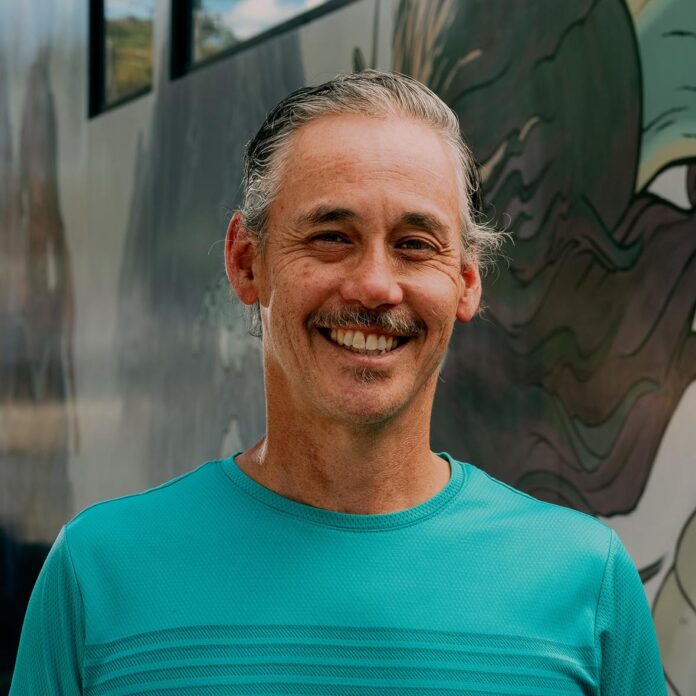
Van Rudd

Hi I’m Van, I’m a public school maintenance worker, artist, soccer coach, father of two and a long-time renter in the western suburbs.

I wasn’t expecting to run for parliament, but I feel something must be done to make sure the wealthy minority at the top of our society don’t further destroy our livelihoods so they can make an extra billion or two. I long to put people before the profits of cold, ruthless corporations and neglectful governments.

We have the ability to create a society based on cooperation, friendship and harmony. One that doesn’t see working class people in the west skipping meals and medical visits just to keep up with paying rent, mortgages and bills. One that doesn’t allow a minority of billionaires to make an average of $50,000 per minute, and one that forbids large companies from dodging tax.

We can build a fruitful life for everyone, including migrants and refugees and actually fix the housing crisis caused by banks, developers and large investors by building thousands of public housing units in the west.

We can fight for a much better world than the cold, dark one we’re living through now.

I have been producing public artworks over many years in Melbourne’s west that question the status quo in Australia and the world. I show that I’m on the side of the oppressed and working class people of the western suburbs – not the billionaires. Themes in these artworks include refugee rights, the struggle for a free Palestine and workers’ struggles for better wages and conditions.

As a maintenance worker and unionist I believe workers’ wages should be much higher (above inflation) and that we deserve much better conditions so we’re not burnt out and so we can afford food and other life necessities.

I took part in the Victorian public education workers strikes this year and twice marched alongside over thirty thousand education staff calling on the state government to fund our schools more, not prisons. We argued for pay rises, thousands more teachers, smaller class sizes and less administrative tasks for teachers and paid lunch breaks for education support workers. And through these strikes, I’m proud to say we won much better pay rates than the lame ones the state government originally put forward.

As a renter living in the western suburbs, I know how costly everyday items have become, that’s why I want to introduce a ’$100 trolley’ scheme providing the opportunity for every Victorian household to purchase a week’s worth of groceries funded directly from supermarket profits.

It’s not easy having to pay for and find time to make our children’s school lunches, so Victorian Socialists will push for free, nutritious school lunches in every public school in Victoria.

Politicians are also way out of touch. An MP receives around $210 000, while minister roles get even more, putting politicians in the top 4% to top 1% of income earners. I believe politicians should be put on an average worker’s wage.

Question 1: Are you aligned with any political parties (for independents) and to where are your preferences going?

I am running as a member of the Victorian Socialists political party. We have a principled stance with preferences prioritising the most left wing progressive parties/independents while making sure the least progressive, conservative and far right groups/independents are placed last.

For example, if you stand for taxing the billionaires, building public housing, freezing rent, reversing privatisation, fighting against racism and welcoming migrants and refugees, you will be prioritised.

Question 2: What is your position on data centres in the western suburbs? Do you think there should be a moratorium? Should they be independently powered by wind, solar, coal, or nuclear?

There should be a moratorium on data centres.

Data centre companies have been given the red carpet treatment by Labor to suck huge volumes of our natural resources and energy supplies just so they can satisfy the investment wishes and future profit margins of billionaire tech bros while further polluting working class suburbs.

Data centres that are already operating should be forced to supply their own wind and solar energy and there should be strict limits around water and electricity usage. Using coal and nuclear energy would only add more danger to our health and the environment and must be avoided. It’s shocking that governments and private investors rush to build these monolithic, resource hungry structures, instead of building infrastructure that can actually make a real difference to people’s health and wellbeing.

Thousands of jobs could be created in the west through the injection of billions of dollars into building more hospitals, allied health centres, schools, public housing, childcare centres (publicly run), community run grocery stores, free public transport and recreational facilities. And the overall benefits of this infrastructure to all people of the western suburbs would be massively increased.

Expanding data centres doesn’t fit into any of these categories of human need.

Question 3: How will you improve public transport options in the west?

I will fight to reverse the privatisation of public transport, make it permanently free and extend it further into the western suburbs so households are not relying on their multiple cars to drive to work and/or places of leisure.

It’s a myth that our public transport is wholly public property. Much of the infrastructure is government owned, but unfortunately most of the operations (such as running the trains) are contracted out to private companies whose main aim is to make profits, so their main purpose isn’t to serve the community, but to compete with other companies over government contracts, and once gaining contracts, proving they can run efficiently by cutting workers’ wages and raising transport fairs (price gouging).

This effectively takes money away from the community and leaves public transport mostly out of our control. We must take it back into our hands in its entirety so we have a much bigger say over its design, reach, cost and sustainability.

I strongly support the ongoing Better Buses campaign that has had successes in providing more electrified bus routes into more areas of the west and for those outer suburbs to be interconnected and not having to bypass the city. These areas have been neglected for far too long by Labor and the Liberals.

It’s also important to provide the necessary infrastructure that surrounds public transport. This includes expanding secure bike parking at public transport hubs such as tram and train stations. Also to upgrade pedestrian infrastructure across the west, including footpaths, crossings, lighting and shade, with priority given to areas near schools, hospitals and public transport stops.

Question 4: What will you do to reduce air pollution in the western suburbs?

I was living in social housing with my family only eight hundred metres from the Tottenham factory fire of 2018.

It heavily polluted the air and waterways and poisoned the firefighters who extinguished the flames. Like many residents nearby, we were forced to pay for accommodation elsewhere to distance ourselves from the toxic air.

Firefighters and locals shouldn’t be exposed to cancerous chemicals and the costs of emergency relocation shouldn’t come out of the pockets of ordinary people.

I remember the local creeks were coloured bright green and smelled acrid after the fire. These social and environmental costs should come out of the deep pockets of polluting industries, not working class communities in the west. I want to end all waste to energy schemes, stop new data centres being built and impose strict penalties on all warehousing and waste companies that ignore health and safety regulations in regards to toxic fires, high air pollution levels and the chemical poisoning of creeks and waterways.

I will also establish a fully funded western suburbs toxic waste taskforce to carry out an immediate audit of every industrial facility and a health study on the effects of these repeated toxic exposures.

Large areas of Laverton are dominated by large industrial zones containing concrete and bitumen. This causes an increase in extreme heat zones where large sections of the local population are exposed to heat related illness and death. This must be wound back.

We need more green spaces, tree shade and parks and a big expansion of bicycle paths and connecting infrastructure that allows people to decrease the use of fossil fuel powered vehicles. This will improve the health and wellbeing of locals while simultaneously reducing the pollution being released into the air.

I know what it’s like to have no choice but to drive to work and that many households in the west operate three or more cars for work and leisure because of the long distances between community facilities and workplaces, that’s why our demand for free public transport and its extension into more suburbs in the west is part of our aims to decrease air pollution while also making life easier for workers in general.

Question 5: How do you propose to deal with homelessness and housing affordability in the West?

As a renter in the west I know what it is like to fear that your landlord and/or real estate company will raise your rent yet again. With private rental property availability sitting at a very low 1% to 2% in Melbourne’s suburbs, you dread the day you might have to start looking for a place to live again and/or end up homeless.

It’s criminal that the private housing market allows over one hundred thousand properties to remain vacant or underused, while around eighty thousand people are on the waiting list for social or community housing. This market driven housing provision is what drives up homelessness, where in the west it is 50% higher than the national average.

To fix this I will demand that a target be set to end rough sleeping in Victoria within six months, and adopt a housing first policy that offers unconditional access to permanent public housing for all homeless Victorians. I will also push for thousands of new public houses to be built in the western suburbs and that the Victorian government immediately stop the demolition of the 44 public housing towers in Melbourne and get to work on lifting the quality of those towers so they’re up-to-date and liveable and that they remain in public hands.

Investment properties that have been sitting empty for longer than two years should be seized and managed by the public sector and not corporatised through ’community’ or ’affordable’ housing schemes.

All new developments must be built by a publicly run construction sustainably and integrated with social and community infrastructure, including public transport, education, health services, parks, playgrounds, other third spaces, recreational and cultural facilities.

I also will fight to impose a 25 percent cut to rent in all residential tenancies followed by a five-year rent freeze and create a Rental Inspectorate Victoria, which will be empowered to investigate complaints against landlords and agents and enforce penalties, introduce rent controls, enforce minimum quality housing standards. Inspect rooming houses and set rooming house rents.

You know something’s very wrong with the housing market when you want to buy a house with a price that is 8 to 14 times higher than your average household income compared to roughly 4 times in 1975. And with high interest rates that add thousands of dollars to monthly payments, it’s no wonder many home owners in the west are highly stressed and cutting back on necessities.

I will fight to establish a State Bank of Victoria that will offer to take over existing owner-occupier mortgages owing on residential properties at below market interest rates. Access to secure, quality housing is a fundamental human right. Homes should not be used as an investment opportunity – a means by which some people can accrue a profit at the expense of others. Owning a home shouldn’t mire you in debt for the rest of your life.

It’s also important to emphasise that migrants are not to blame for the housing crisis. The banks and developers and large investors have rigged the housing market to pinch every dollar and cent from your already empty pocket. They should be blamed instead.

Question 6: What is your policy on abortion?

I believe in women’s right to freely accessible abortion. Abortions should be available in all public hospitals and should be provided without any exemptions based on religion.

I want to increase access to medical abortion by funding training for GPs and developing nurse-led models of abortion care and recognise women’s right to control their bodies and reproductive function at any point in a pregnancy. Not doing so endangers the lives of women by forcing them to seek unregulated abortion methods and further exposes them to violence, poverty, abuse and oppression.

This policy is part of our wider struggle for the liberation of women from their chains of oppression. This profit driven system thrives on women’s unpaid labour in the home and views it as a natural biological feature of being female. It imposes that sexist view onto our children through mainstream education, commercial television and in social media. Consequently, it hardens the view that women shouldn’t have the right to decide what to do with their own bodies.

This gender division creates billions of dollars in savings each year for the wealthiest sections of society and explains the fact that most care focused jobs like early education, teaching and aged care are dominated by women. Their push to keep women’s pay low ensures it’s also a constant struggle to lift the wages of both women and men in general.

We made a huge impact on this wage disparity when I took part in this year’s teachers and education support workers’ strikes. We succeeded in significantly lifting the wages for all staff in a female dominated industry by forcing the government to revise its earlier sub-standard offer. Inspired by striking nurses only a few years earlier, it was truly amazing to be on the streets with thousands of people demanding the pay and conditions we deserve and to send a message to our children that it is good to fight for better pay and conditions of female dominated industries, and henceforth, that of all workers.

Question 7: What should be done to combat crime?

Victoria has a comparatively low crime rate, and the city of Melbourne consistently ranks in the top ten of global safe cities. Yet the growth of the prison population far outweighs the growth of the general population.

This is the result of longer prison sentences and persistent increases in the number of people detained. It includes increases in the number of women, Aboriginal and people of colour being imprisoned. Racist and punitive policies have caused a spike in imprisonment, at the same time as the number of offenders per capita has trended downwards over the last decade.

The ‘law and order’ policies promoted by big business, media and their politicians seek to criminalise poverty and marginalisation, and simultaneously scapegoat people of colour and the poor and people with disabilities and/or mental health challenges for social ills, diverting public anger away from the systemic causes created by capitalism.

The crimes of companies and politicians causing growing inequality and marginalisation are left unpunished — wage theft, financial speculation, tax evasion, developer profiteering, real estate fraud and so much more.

I will fight to implement economic and social policies that address the causes of crime, and replace punitive justice with rehabilitative and restorative approaches wherever possible. We aim to gradually reduce reliance on prisons as social conditions improve and community-based forms of justice become more effective.

Our social justice policies would massively reduce crime, including: Universal housing; secure and well paid employment; properly funded public education; universally accessible and preventive healthcare (including mental health and drug and alcohol support); and a massive expansion of community services (such as neighbourhood houses, youth centres etc).

The diversion of public money to running prisons takes away from funding for such services, and from programs that help people to deal with social alienation and to break the cycles of criminal offences.

Share

Lower house districts

Parties

Subscribe

Related articles